From My Mother's Kitchen to Michelin Stars: My Journey to Cooking for the World

People ask me a lot how a boy who grew up watching his mother cook in North India ends up designing tasting menus for clients in Saint-Tropez and Monaco. Honestly, there's no single answer. It's twenty years of small decisions that all pointed the same direction — toward food, and toward doing it properly.
I want to actually tell that story here, in my own words, rather than the shorthand version you'll usually find on a menu card.
Where It Actually Started
I didn't grow up planning to be a chef. I studied commerce. I have a BBA. But the kitchen was always where I paid attention — the smells, the noise, the way my mother could turn a handful of spices into something that filled the whole house. I didn't have language for it then, but I was already studying it.
That curiosity eventually led me to the Institute of Hotel Management in Aurangabad, where I graduated in 2004 with both my business degree and a diploma in culinary arts. It gave me something a lot of chefs skip early on — an understanding of the business side of food, not just the cooking of it. That's turned out to matter more than I expected.
Mumbai, and Learning From Jiggs Kalra
My first real kitchen years were in Mumbai, working alongside Jiggs Kalra — genuinely one of the most important names in modern Indian cuisine. Four years there taught me things you can't get from a textbook: pace, discipline, respect for ingredients, and what authentic Indian food actually tastes like before anyone tries to "elevate" it.
Those four years are the foundation everything else sits on. Whatever I do now with French technique or European produce, it still starts from what I learned in that kitchen.
Moving to the UK
In 2007, I moved to the UK. It was a genuine culture shock, professionally — suddenly I was inside French fine-dining kitchens, working to the standard of 3 AA Rosettes and Michelin stars. The precision was a different world. Nobody was cutting corners. Every plate had to be exactly right, every single service.
That's really where my style as a chef started to form — not by abandoning what I'd learned in Mumbai, but by adding a second language on top of it.
The Roux Scholarship Years
Between 2010 and 2013, I competed for the Roux Scholarship three times — a two-time semi-finalist, and a finalist in 2012. If you know the industry, you know what that competition means: it's run by the Roux family, rooted in classical three-Michelin-star French standards, and it doesn't let you get away with anything.
Through it, I got to train in kitchens most chefs only dream about. I did my stage at The Waterside Inn, absorbing the kind of precision and elegance that defines classical French cooking. I spent time in the kitchen at Le Gavroche — a restaurant that shaped generations of chefs before it closed its doors earlier this year, and I'm genuinely glad I got to experience it while I could. And at Restaurant Sat Bains, I saw an entirely different, far more modern and technical way of building flavour.
Three kitchens, three completely different philosophies. Between them, I built a classical backbone that still underpins everything I cook today, however modern it looks on the plate.
MasterChef: The Professionals, 2019
Competing on MasterChef UK in 2019 and reaching the Top 4 in the semi-finals was one of the most exposing experiences of my career — in the best way. Cooking under that kind of scrutiny strips away anything you're hiding behind. You can't lean on technique alone. You have to be honest about who you are as a chef.
That experience changed how I think about a plate of food. It's not enough to be technically correct. Every dish needs a story, a sense of place, something personal underneath it. That idea has shaped every menu I've written since.
Where Indian Meets European
These days, my cooking lives at the meeting point of two worlds. Mumbai gave me authenticity and technique. The UK and Europe gave me access to extraordinary produce — Mediterranean citrus, Alpine dairy, Riviera seafood — and a more refined, restrained way of plating.
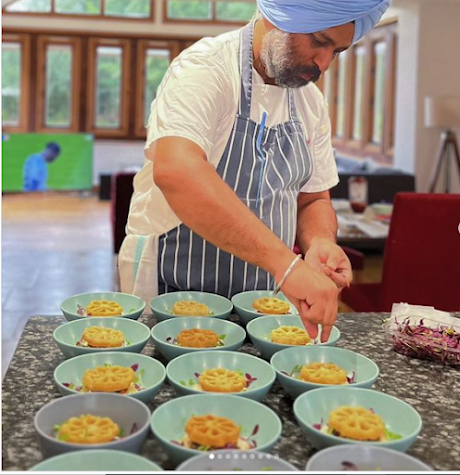
I'm not trying to make Indian food "fancy." I'm trying to let it sit confidently on the same stage as any other cuisine in the world, using precision and story to get it there. That's the whole idea behind ASD, the consultancy and luxury dining venture I've built — high-end dining concepts and destination experiences that carry Indian flavour with European technique, for clients across Monaco, the French Riviera, Saint-Tropez, St. Moritz and beyond.
Why Sustainability Isn't an Afterthought
Whether I'm building a menu for a private wedding or advising a restaurant brand as a consultant, sourcing responsibly isn't a box I tick at the end. I work directly with local farmers and small producers, I design dishes that use the whole ingredient, and I look for genuine cross-utilisation across a menu so nothing goes to waste.
For the clients I work with — often UHNW and high-net-worth individuals who could have anything — that matters more than people assume. It's not just an operational choice. It becomes part of the story of the menu itself.
What's Next
What genuinely excites me about Indian food right now is watching its regional depth finally get the attention it deserves — coastal traditions, tribal cooking, heirloom techniques that almost disappeared. It's pushing Indian cuisine past the stereotypes and letting it stand on the world stage with real nuance.
That's the direction I want to keep pushing in — through private dining, through consultancy work, through collaborations that put a genuinely honest, regional version of Indian food in front of a global audience. I'm continuing to grow ASD across Europe, the Middle East, and other key destinations, but the goal underneath all of it stays the same: food that tells the truth about where it comes from.
If you're planning a private dining experience, a destination celebration, or you're a hospitality brand looking for consultancy support, I'd love to hear what you're building. Get in touch to talk it through.


Comments
Post a Comment